The moment the examiner walks towards the car, most learners stop worrying about clutch control or parallel parking and start wondering what happens during a driving test. The good news is that nothing is designed to catch you out. The practical test follows a clear structure, and every part is based on the safe driving skills you have been building in your lessons.
Your examiner is not looking for a flawless performance or a perfectly smooth drive on every road. They are checking whether you can drive independently, safely and with good judgement. A small mistake does not automatically mean you have failed. What matters is how safely you respond and whether your driving puts anyone at risk.
What happens during a driving test: the test-day order
The UK practical driving test normally lasts around 40 minutes. You will drive on a mix of road types, follow directions independently for roughly 20 minutes, complete one manoeuvre and answer two vehicle-safety questions.
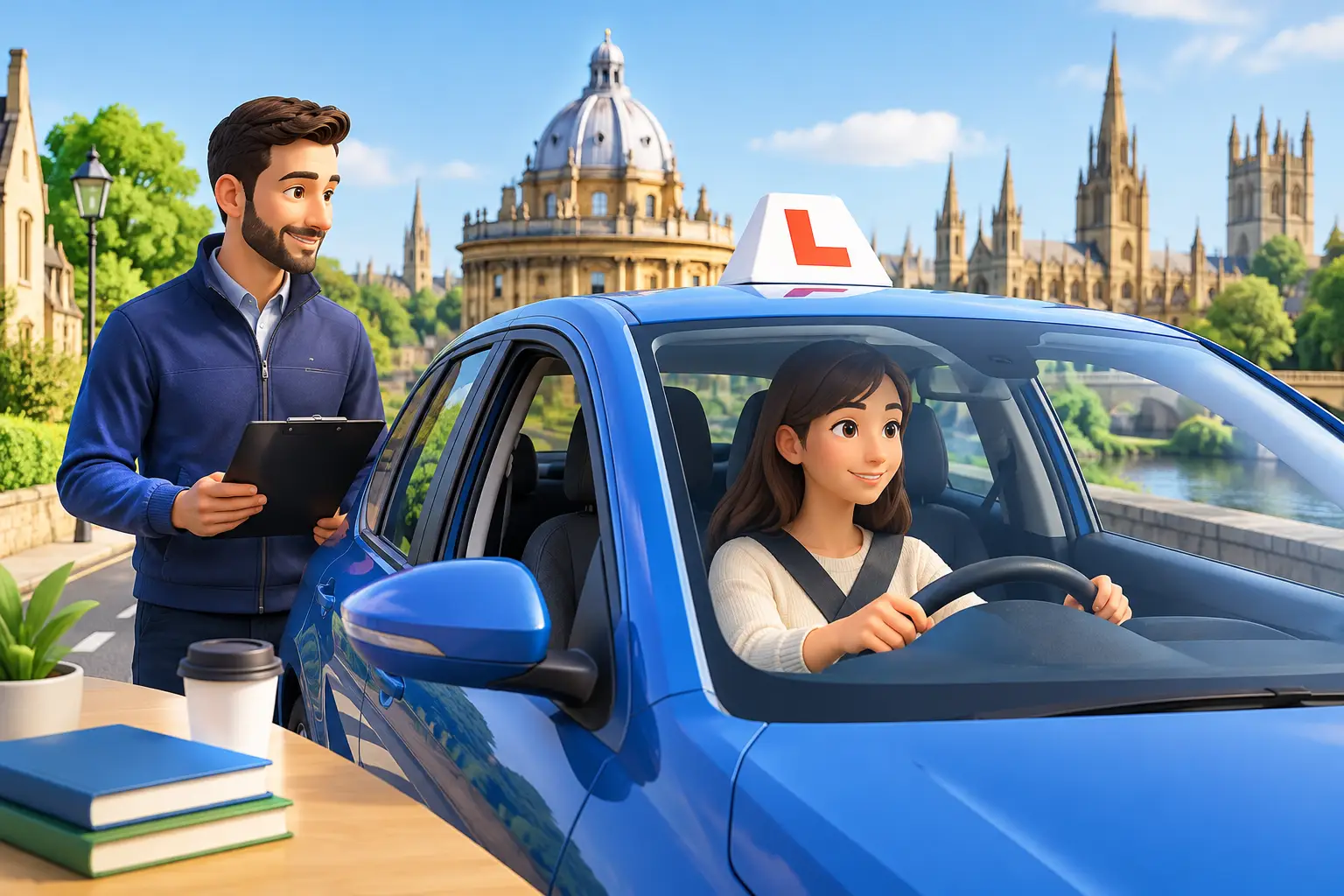
You should arrive at the test centre around 10 minutes before your appointment. Bring your provisional driving licence. If you are using your own car, it must be taxed, insured for the test, roadworthy and display L-plates on the front and rear. It also needs an additional interior mirror for the examiner. Many learners choose to take their test in their instructor’s dual-control car because it is familiar and has been checked for test-day requirements.
Meeting the examiner and the eyesight check
When your name is called, the examiner will check your licence and ask you to read a number plate from a distance of 20 metres for vehicles with the newer-style registration plate. You can wear glasses or contact lenses if you normally need them for driving.
Take your time, breathe and ask politely if you did not hear an instruction. You must be able to read the number plate correctly to continue with the test, so make sure you bring your usual driving glasses.
The examiner will then ask whether you would like your instructor to sit in the back. This is entirely your choice. Some pupils feel more comfortable with a familiar face there, while others prefer fewer people in the car. Your instructor cannot help during the test, but they can listen to the feedback at the end.
The “tell me” question before you set off
Before driving away, you will be asked one “tell me” vehicle-safety question. This checks that you understand basic car safety rather than that you can recite complicated mechanical information.
For example, you might be asked how you would check that the brakes are working before a journey, how to check tyre tread depth, or how you would make sure the headlights and tail lights are operating. Your instructor should practise these questions with you until your answers feel natural and clear.
Getting this question wrong is recorded as a driving fault, not an automatic fail. It is worth preparing properly, but there is no benefit in panicking over one answer.
The drive itself: normal roads, real decisions
Once you move off, the examiner will give you directions in plenty of time. They may ask you to turn left at the end of the road, take the next available road on the right, or follow the road ahead at a roundabout. If you do not hear or understand an instruction, ask them to repeat it. Taking a wrong turn is not a fault as long as you do it safely.
The route is not a secret test of local knowledge. You may drive through residential streets, on busier main roads, at roundabouts, through junctions, past parked cars and on roads with changing speed limits. The examiner is watching how you observe, plan and respond to what is actually happening around you.
In Oxford and Oxfordshire, that can mean managing busy roundabouts, narrow roads with parked vehicles, cyclists, bus lanes, pedestrian crossings and varied traffic flow. You should not try to memorise a route. Instead, focus on the habits that work anywhere: read signs early, check mirrors before changing speed or direction, choose an appropriate position and leave enough space.
You may make a minor error such as choosing a gear that is slightly too high or needing a second attempt to park. If you recognise it and deal with it safely, it may only be marked as a driving fault. However, poor observation when emerging at a junction, forcing another road user to react, or ignoring a red light could be marked as serious or dangerous.
Independent driving: following a sat nav or traffic signs
For about 20 minutes of the test, you will drive independently. Most candidates follow directions from a sat nav provided by the test centre. Others may be asked to follow road signs instead.
The sat nav is there to give directions, not to judge your driving. You do not need to operate it, and the examiner will set it up. Keep looking at the road and use the device only as a prompt. If the sat nav instruction conflicts with a road sign, road marking or safe decision, follow the road sign and drive safely.
A wrong turn does not matter. The examiner will simply redirect you. What does matter is trying to correct a wrong turn suddenly, such as swerving across lanes or braking sharply. Missing a turn calmly is always better than making an unsafe last-second decision.
Your manoeuvre and possible emergency stop
You will be asked to complete one reversing manoeuvre. This could be parallel parking at the side of the road, bay parking forwards or backwards, or pulling up on the right-hand side of the road before reversing for around two car lengths and rejoining traffic.
The examiner wants to see effective all-round observation, low-speed control and sensible judgement. It is fine to pause and take another look. If another vehicle, cyclist or pedestrian approaches, put safety first and wait where necessary. A manoeuvre does not need to look polished; it needs to be controlled and safe.
Around one in three candidates is also asked to carry out an emergency stop. If you are selected, the examiner will explain that they will give you a signal to stop. Until that signal, continue driving normally. When asked, stop promptly under control, secure the car and check around before moving off again.
The “show me” question while driving
During the drive, you will be asked one “show me” question. This may involve showing how you would demist the rear windscreen, use the front demister, operate the horn or wash and clean the windscreen.
The key is to carry out the instruction only when it is safe. If you need to wait until the road is straighter or traffic has cleared, that is sensible driving. The examiner is assessing whether you can use a control without losing focus on the road.
How the driving test is marked
At the end of the test, the examiner will tell you whether you have passed and explain any faults recorded. You can pass with up to 15 driving faults, often called minors, provided there are no serious or dangerous faults.
A driving fault is an error that does not create danger but needs improvement. Repeating the same issue several times can become serious because it shows a pattern. For example, a single missed mirror check might be a driving fault, but repeatedly failing to check mirrors before changing direction may lead to a more serious result.
A serious fault is something that could cause danger, while a dangerous fault involves actual danger to you, your passenger or another road user. The result always depends on the situation. Stalling, for example, is not an automatic fail. Stalling and then rolling into traffic because you have not secured the car is a very different matter.
Preparing for a calmer test day
Nerves are normal, including for learners who have driven confidently for weeks. Give yourself the best chance by arranging a lesson before the test if your instructor recommends it, eating something light, wearing comfortable shoes and arriving with time to spare.
Treat the test as another supervised drive rather than a performance. Keep your routine: mirrors, signal, position, speed and look. If something goes wrong, do not spend the next ten minutes trying to work out whether you have failed. Reset, focus on the next hazard and keep driving safely.
A realistic mock test is one of the most useful ways to prepare because it makes the format familiar before the pressure is real. At Oxford Driving Academy, mock tests are designed to identify the small habits that can make a difference, from roundabout approach speed to observations during manoeuvres.
Your practical test is one drive, not a verdict on your ability or potential. Prepare carefully, listen to the road rather than your nerves, and give yourself permission to make safe, calm decisions all the way to the test-centre car park.