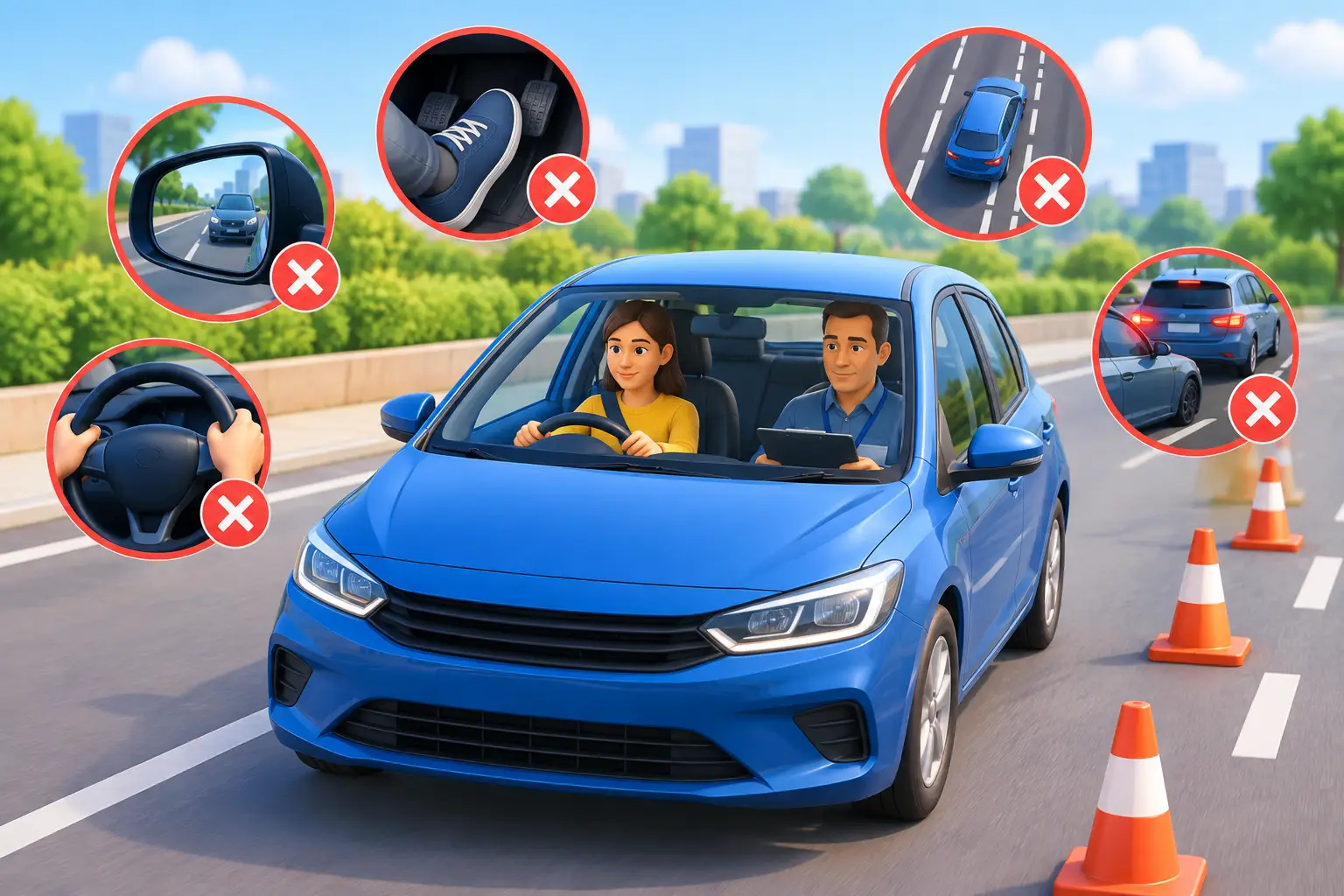
A clean drive is not about being perfect for 40 minutes. It is about showing the examiner that you can make safe, sensible decisions independently. Understanding driving test faults removes much of the uncertainty that makes learners tense, especially when you are approaching a test in Oxford’s busy junctions, roundabouts and changing traffic conditions.
The practical driving test assesses your overall standard of driving, not whether you drive exactly like your instructor. You may make a small mistake and still pass. What matters is whether that mistake affects safety, control or other road users.
How driving test faults are marked
The DVSA examiner records faults on the driving test report using three main categories: driving faults, serious faults and dangerous faults.
A driving fault is often called a minor. It means something was not quite right, but it did not create danger. For example, you might check a mirror slightly late before signalling, select a gear less smoothly than usual, or need an extra attempt to position the car neatly in a bay.
You can pass with up to 15 driving faults, provided you have no serious or dangerous faults. However, that number is not a target. A test with several similar faults may show a developing weakness, and repeated driving faults in the same area can be marked as serious if they demonstrate an ongoing safety issue.
A serious fault means there was potential danger. You may have caused another road user to slow down, failed to make safe progress at a junction, or positioned the car incorrectly in a way that could have affected others. A serious fault results in a failed test.
A dangerous fault means there was actual danger. This might include pulling out when another vehicle has to take avoiding action or continuing when a pedestrian is clearly at risk. A dangerous fault also results in a failed test.
The distinction can feel fine, but it is based on the situation around you. Missing a mirror check on an empty road may be a driving fault. Missing it before moving into the path of a cyclist could become serious or dangerous. This is why instructors teach routines rather than asking you to simply memorise a list of rules.
Common driving test faults and what causes them
Most faults are not caused by a lack of ability. They usually happen when a learner is rushed, distracted by nerves, or tries to anticipate the examiner instead of concentrating on the road ahead.
Observation and mirrors
Observation faults are common because good checks can be easy to do but easy to forget under pressure. Before moving off, changing direction, slowing down, turning or entering a roundabout, use your mirrors early enough for the information to influence your decision.
The key is not dramatic head movement for the examiner’s benefit. Check naturally and respond to what you see. If a cyclist is behind you, for example, give them the space and time they need rather than signalling and turning immediately.
When moving off, remember the full observation routine. A quick glance is not always enough. Check the relevant blind spot, particularly when pulling away from the left-hand side of the road.
Junctions and roundabouts
Junctions test several skills at once: approach speed, lane position, mirrors, observation, judgement and control. Learners often focus so hard on finding a gap that they forget to prepare the car properly before they reach the give-way line.
Approach slowly enough that you can assess the situation. Choose the correct gear before the junction where possible, rather than coasting in neutral or trying to change gear at the last moment. At roundabouts, use the lane markings and road signs, then keep checking for vehicles, cyclists and pedestrians as the situation develops.
Oxford and Oxfordshire routes can include busy multi-lane roundabouts, narrow residential roads and junctions with limited visibility. Your examiner will not expect you to force progress where it is unsafe. A safe wait is almost always better than a rushed decision.
Speed and progress
Driving too fast is an obvious concern, but driving unnecessarily slowly can also lead to faults. If the road is clear and the speed limit allows it, the examiner expects you to make reasonable progress.
That does not mean driving at the limit regardless of conditions. In rain, poor visibility, heavy traffic or on a narrow road with parked cars, a lower speed may be the right choice. The skill is showing that you can read the road and adjust accordingly.
Be especially alert to changing limits. Look for signs when entering built-up areas, leaving villages and approaching roadworks. Do not rely on the car in front to decide your speed for you.
Positioning and clearance
Poor road position can create faults at bends, roundabouts, meeting traffic and when passing parked vehicles. Keep a safe distance from parked cars in case a door opens, but do not move so far right that you enter the path of oncoming traffic.
On narrow roads, plan ahead. Look for passing places, identify gaps between parked vehicles and be prepared to give way calmly where appropriate. If another driver waves you through but you cannot see that it is safe, make your own assessment. Courtesy never replaces observation.
Manoeuvres and control
The test may include one manoeuvre, such as bay parking, parallel parking or pulling up on the right and reversing. A manoeuvre does not need to be completed in one effortless movement. You can correct your position if it is safe to do so.
What matters is all-round observation and low-speed control. Stop if you are unsure, re-check your surroundings and continue only when it is safe. During a forward or reverse bay park, do not become so focused on the lines that you miss a pedestrian walking behind the car.
For manual learners, stalling is not an automatic fail. Secure the car, restart calmly and move away safely. The fault, if any, depends on the effect of the stall. For automatic learners, smooth brake control and careful creeping at low speeds deserve the same attention.
How to reduce faults before your test
The most productive preparation is targeted practice. Rather than repeating familiar roads because they feel comfortable, use lessons to revisit the situations that make you hesitate.
Ask your instructor to identify patterns in your driving. Perhaps your mirrors are reliable on normal turns but late when changing lanes. Perhaps your clutch control is strong on flat roads but inconsistent on hill starts. Once you know the pattern, you can practise the exact routine until it becomes dependable.
Mock tests are particularly useful because they reveal what happens when you must drive independently and listen to directions at the same time. At Oxford Driving Academy, realistic mock tests can help learners experience the pace of the test, including independent driving, manoeuvres and common local road features, before test day.
Use any mistakes in a mock test as information, not a verdict. A serious fault during practice can be frustrating, but it gives you a clear priority for the next lesson. The aim is not to collect fault-free mock tests. It is to understand why an error happened and show that you can correct it.
What to do if you make a mistake on test day
Many learners believe one imperfect gear change, missed turn or awkward manoeuvre means the test is over. That thought can turn a small driving fault into a series of avoidable errors.
If you make a mistake, keep driving safely. The examiner will tell you if they need you to take a different route or repeat an instruction. Missing a turn is usually not a problem. Follow the road safely, wait for the next instruction and avoid sudden steering, braking or lane changes to recover the original route.
Give yourself time at every decision point. Breathe, check mirrors, read signs early and prioritise safety over speed. You are allowed to ask the examiner to repeat an instruction if you did not hear it clearly. It is far better to clarify than guess.
Build a driving standard that lasts
The best way to avoid driving test faults is not to drive as though every decision has a hidden trick. It is to build calm routines that work on an unfamiliar road, in traffic and when you feel nervous. When observation, planning and safe control become your normal driving habits, the test becomes one journey where you show what you can already do.